Boost your learning experience get connect with the growing global learning network JOIN NOW visit www.taaray.com
Scientists Invent Particles That Will Let You Live Without Breathing !
This may seem like something out of a science fiction movie: researchers have designed micro-particles that can be injected directly into the bloodstream to quickly oxygenate your body, even if you can't breathe anymore.
It's one of the best medical breakthroughs in recent years, and one that could save millions of lives every year.
The invention, developed by a team at Boston Children's Hospital, will allow medical teams to keep patients alive and well for 15 to 30 minutes despite major respiratory failure. This is enough time for doctors and emergency personnel to act without risking a heart attack or permanent brain injuries in the patient.
The solution has already been successfully tested on animals under critical lung failure. When the doctors injected this liquid into the patient's veins, it restored oxygen in their blood to near-normal levels, granting them those precious additional minutes of life.
Particles of fat and oxygen
The particles are composed of oxygen gas pocketed in a layer of lipids, a natural molecule that usually stores energy or serves as a component to cell membranes. Lipids can be waxes, some vitamins, monoglycerides, diglycerides, triglycerides, phospholipids, or—as in this case—fats.
These fatty oxygen particles are about two to four micrometers in size. They are suspended in a liquid solution that can be easily carried and used by paramedics, emergency crews and intensive care personnel. This seemingly magic elixir carries "three to four times the oxygen content of our own red blood cells."
50 Amazing Science Facts
- There are 62,000 miles of blood vessels in the human body – laid end to end they would circle the earth 2.5 times.
- The largest organ in the body is the skin. In an adult man it covers about 1.9m2 (20sq ft). The skin constantly flakes away – in a lifetime each person sheds around 18kg (40 lb) of skin.
- Each kidney contains 1 million individual filters. They filter an average of around 1.3 litres (2.2 pints) of blood per minute and expel up to 1.4 litres (2.5 pints) a day of urine.
- The focusing muscles of the eyes move around 100,000 times a day. To give your leg muscles the same workout, you would need to walk 80km (50 miles) every day.
- Brain is capable of having more ideas than the number of atoms in the known universe!
- A single rye plant can spread up to 400 miles of roots underground.
- The evaporation from a large oak or beech tree is from 10-25 gallons in 24 hours.
- Plants cannot change their habitat.
- Petals are usually colourful, and they attract insects and birds that help with pollination.
- Onions contain a mild antibiotic that fights infections, soothes burns, tames bee stings and relieves the itch of athletes’ foot.
- Shark’s need to swim, or they will sink!
- All dogs are identical in anatomy - 321 bones and 42 permanent teeth
- An ostrich’s eye is bigger than it’s brain.
- A duck’s quack doesn’t echo, and no one knows why.
- Butterflies taste with their feet.
- A plastic cup can take 50 - 80 years to decompose. About 14 billion pounds of plastic is dumped in the world’s oceans every year.
What is Monsoon ? Short Story !
Most of you will promptly say that monsoon is the rainy season. Monsoons in fact are some very strong winds. Thing to remember is that these winds,monsoon, always blow from cold to warm places.
In summers, when centre and north of India becomes very hot, winds(monsoon) from over the Indian Ocean blows towards this hot region. On their way these winds absorb a lot of water from the Indian ocean. So now imagine this wind carrying infinite number of tiny water balloons with it.
Soon this wind reaches the southern tip of India ( remember the ‘V’ of india, that’s the southern tip!) . Here they hit the mountains of India – Western ghats on the west and Eastern ghats on the east.
Now you know what happens when water balloons hit a hard surface? They burst into a splash of water! That is exactly what happens when the water laden wind hits the Indian mountains. The infinite tiny water balloons burst, releasing water and resulting in rains.
These monsoon winds don’t stop here and travel across a large part of India giving us our rainy seas
Test IQ 60 - Instant Quiz 60 Seconds Now Live !
Instant Quiz 60 Seconds LIVE at www.taaray.com
Just Answer a Simple Question in 60 Seconds & Grab a Chance to WIN weekly surprise reward
FREE Registrations are ON at www.taaray.com
Participate NOW !
Top 10 Tiny Animals With Enough Poison To Absolutely Destroy You
Most people would steer clear of any snakes or over-sized spiders that crossed our paths. We have a sort of logic when it comes to animals that tells us “Bigger = Deadlier.” And in the case, say, a King Cobraversus a garden snake, that argument checks out.
But more often, you will often find that the opposite is true. Many animals make up for their small size with deadly venom, and so what may look like a regular snail could actually be your final downfall. Below are ten tiny, but incredibly deadly, animals.
10. Sonoran Coralsnake
These snakes, related to cobras, are found in the deserts of Mexico and the Southern US. While they can grow to about two feet, they usually don’t, and are much smaller and skinnier than most other snakes. As if they’re not hard enough to see, due to their size, they tend to be nocturnal.
Lucky for us, they prefer to indulge in cannibalism, snacking almost exclusively on other snakes. But if you do decide to pick one up and play with it, beware: their venom is a powerful neurotoxin that can paralyze your central nervous system.
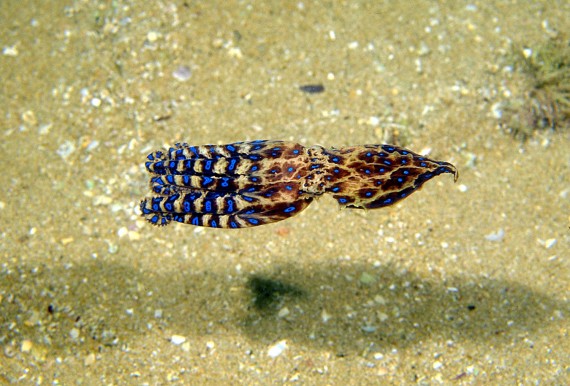
9. Blue Ringed Octopus
Try to forget about starting another grammar war over whether it’s “octopuses” or “octopi,” and try to focus on how this thing will straight-up kill you. The Blue Ringed Octopus can be found in the waters aroundAustralia, and measure up to a whopping 4 inches in size. Usually it is a brown or yellow color but, when frightened, its blue rings will light up all over its body.
However, as pretty as it is, do not touch! The tiny critter has an incurable venom toxic enough to kill 26 adults humans in a matter of minutes.
So called because they hunt prey, as opposed to spinning webs, the Brazilian Wandering Spider has been recognized since 2007 as the spider with the most powerful venom in the world, and the one responsible for the most human deaths. Most victims will die within an hour of being bitten.
The spider, which can grow to have a leg span of 4 inches, is also known as the banana spider, as it tends to hide inside between bunches of bananas and then jump out at their prey. In 2008, one was found in a crate of bananas in Britain. It was caught with a pencil, since that’s logically the best tool to approach the most dangerous spider alive with, before humanely putting them. By that, we naturally mean “blow them up as violently as possible.”
7. Deathstalker Scorpion
Deathstalker scorpions are mainly found throughout Africa and Asia in mainly dry, desert habitats, measuring up to 4 inches, but usually around 2. They are considered to contain among the most powerful and painful scorpion venom in the world, which can cause fever, convulsions, paralysis and death.
When it comes to scorpions in general, the smaller the pincer, the more powerful the venom. While many people would probably assume the opposite, this is because those with large pincers can rely on the force of their bite to get their message across, while those with small ones need toxins to defend themselves.
6. Tarantula Hawk
Actually a type of wasp, there are 15 species of tarantula hawks in North America, and they can grow to be about 2 inches long. They are so called because they hunt tarantulas, stinging and paralyzing them. The Tarantula hawk will then lay eggs in the spider, and bury it alive. When the eggs hatch, they will eat the spider alive for 35 days.
So unless you’re a tarantula, that’s not something you need to worry about. But that doesn’t mean you have nothing to worry about, since its venomous sting is meant to be the second-most painful sting in the animal kingdom.
Interesting Geography Facts
Alaska
More than half of the coastline of the entire United States is in Alaska.
Amazon
The Amazon rain-forest produces more than 20% of the world's oxygen supply.
The Amazon River pushes so much water into the Atlantic Ocean that, more than one hundred miles at sea off the mouth of the river, one can dip fresh water out of the ocean.
The volume of water in the Amazon river is greater than the next eight largest rivers in the world combined and three times the flow of all rivers in the United States.
Antarctica
Antarctica is the only land on our planet that is not owned by any country. Ninety percent of the world's ice covers Antarctica. This ice also represents seventy percent of all the fresh water in the world. As strange as it sounds, however, Antarctica is essentially a desert.
The average y early total precipitation is about two inches. Although covered with ice (all but 0.4% of it), Antarctica is the driest place on the planet, with an absolute humidity lower than the Gobi desert.
Brazil
Brazil got its name from the nut, not the other way around.
The Future of Education
![]() |
| Image: Kalexanderson on Flickr |
Google, Cyborgs, and the Future of Education
By: Joe Federer, TeachHUB.com
Beyond the information revolution: How will technology change the classroom?
It’s been an interesting week in science and technology – from the mind-controlled bionic hand that can sense what it’s holding to the human ear created using a 3D printer and live cells to the announcement that Google Glass, Google’s augmented reality glasses, will hit shelves sometime in 2013.
At first glance at a product like Google Glass, many teachers may ask themselves - Well how do we keep kids from cheating if all of the information in the world is available in the periphery of their glasses? But that question has built into it an assumption about education which may not be true for long.
IQ60 Going LIVE at TaaRay.com
Instant Quiz 60 Seconds LIVE at http://www.taaray.com/
Just Answer a Simple Question in 60 Seconds & Grab a Chance to WIN weekly surprise reward
Register FREE and Participate NOW at http://www.taaray.com/
Instant Quiz 60 Seconds Just Answer a Simple Question in 60 Seconds & Grab a Chance to WIN weekly surprise reward
Just Answer a Simple Question in 60 Seconds & Grab a Chance to WIN
Weekly Surprise Reward
FREE Registrations are ON at www.taaray.com
Register NOW !!
FlipQ FREE eLearning App for Android Mobile
Welcome to free world of flip questions., FlipQ is an innovative product created by experts which helps students to learn.
To download directly on your android mobile
Hit : market:// search?q=flipq&c=apps - from your android mobile.
To download directly from web hit:https://play.google.com/ store/ search?q=com.platys.fc4g&c= apps
To download directly on your android mobile
Hit : market://
To download directly from web hit:https://play.google.com/
Largest Gun Ever "Gustav Gun"
![]() |
| Hitler looking at the Gustav Railway gun. |
Two types of projectiles were fired using a 3000lb. charge of smokeless powder: a 10,584 lb. high explosive (HE) shell and a 16,540 lb. concrete-piercing projectile. Craters from the HE shells measured 30-ft. wide and 30-ft. deep while the concrete piercing projectile proved capable of penetrating 264-ft. of reinforced concrete before exploding! Maximum range was 23 miles with HE shells and 29 miles with concrete piercing projectiles. Muzzle velocity was approximately 2700 f.p.s.
Three guns were ordered in 1939. Alfried Krupp personally hosted Hitler and Albert Speer (Minister of Armaments) at the Hugenwald Proving Ground during formal acceptance trials of the Gustav Gun in the spring of 1941. In keeping with company tradition, Krupp refrained from charging for the first gun - 7 million Deutsch Marks were charged for the second (named Dora after the chief engineer's wife).
Thousand Year Old World’s Largest Cashew Tree- Maior Cajueiro do Mundo.

In 1994, the Guinness Book of Records set aside a separate column for the world’s largest cashew tree called Maior Cajueiro do Mondo located in Natal, Brazil. The gigantic tree has grown from an amalgamation of two genetic tissues. Such tissues allow the branches of the tree to grow outwards rather than upwards. Gradually, hence, the branches tend to stoop towards the ground and eventually make for a root. This new root further grows into a new tree.
The massive tree occupies 80,000 square feet of land or roughly five acres. It is guessed to be around thousand years old. One can easily climb a tower to view this tree from a vantage point or for that matter, even climb up through the roots.
You can heartily go and pay a visit to this enormous work of nature. However, beware of the orange caterpillars. These gorgeous looking insects are poisonous. They swamp over the tree seasonally and are a size of a finger.
The beauty of this tree is that it produces 60,000 pieces of cashew fruit each year. As for some people it may come as a surprise that a cashew nut is not the fruit but a single nut is attached only to the bottom of the fruit!
Find More FREE Learning Content Visit
Amazing Peacock Spiders
In Australia there are many species of Spider,
but one very small variety, found so far only in Queensland and New South
Wales, is ‘Maratus Volans’. Also known as the Jumping Peacock Spider, the
miniature males have truly amazing colours of iridescent red, green and blue,
among others. The head and breast parts of this spectacular beast are usually
very dark with red stripes, while the upper abdomen area is green, blue and
red. That is not the end of the story, however, because, like peacocks, male
spiders also possess a sort of cape or flap around their abdomen which they can
raise for display whilst courting.
These
dramatic-looking spiders may seem like they're getting ready to attack, but
this colorful display from male peacock spiders is in fact a mating ritual.
Similar to
peacock birds, where this spider gets its nickname from, the male flashes it’s
brightly colored, iridescent stomach flaps in a bid to attract females. And even if these arachnids did attack, they
wouldn't get far because the adults only grow to about 5mm long.
Male peacock
spiders extend their legs and flash their colorful, iridescent abdominal flaps
to attract a mate.
Peacock
spiders are members of the jumping spider’s family, renowned for being tiny.
Adults only grow up to around 5mm in length.
While the
male peacock spiders carry out their mating ritual, the females carefully study
the coloring, vibrations and movements to make sure the potential suitor is
healthy and the correct species to mate with.
This is the
Maratus harrisi species of peacock spider that is traditionally found in the
Namadgi National Park in New South Wales. The ruler is shown for scale.
When a male
peacock spider senses a female it will begin the mating ritual by lifting its
legs and flashing its stomach in a sequence that looks like a dance routine.
The females
carefully study the coloring, vibrations and movements of the male to make sure
the potential suitor is healthy and the correct species to mate with.
Once he has
mated, he will repeat this dance with as many females as he can find and
Maratus spiders can have multiple partners at one time.
There are 20
known species of peacock spiders living in Australia, yet they're so hard to
come by only eight have been formally identified.
Find More FREE Learning Content Visit: http://www.taaray.com/
Subscribe to:
Posts (Atom)